




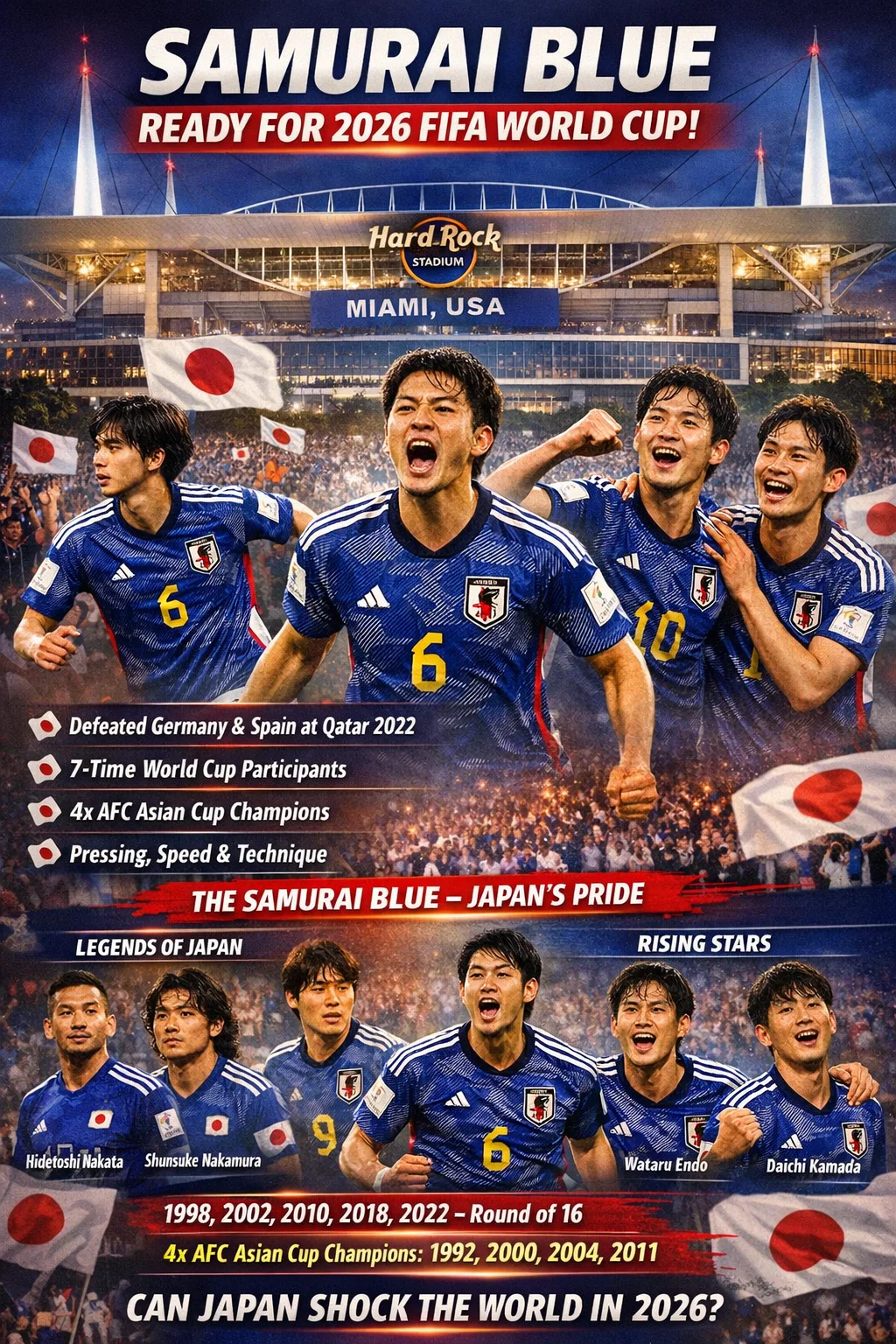
As the football world eagerly anticipates the Hard Rock Stadium FIFA World Cup 2026, which will host crucial matches, including a quarter-final, one team that has the potential to grace that prestigious pitch is Japan. The “Samurai Blue” are not just participants; they are a movement, representing Asia’s most consistent and technically advanced footballing nation. With a record seven World Cup appearances and a growing reputation for dismantling European giants, Japan’s journey to Miami is one of the most compelling storylines. Their disciplined, high-pressing style and a squad brimming with talent from the Premier League and Bundesliga make them a dark horse capable of reaching the later stages of the tournament, potentially culminating in a historic clash at the iconic Hard Rock Stadium.
Japan’s national football team is a powerhouse in Asia. It plays under the Japan Football Association, which was formed in 1921. Japan’s status in international football is very high, having played in the most World Cups in Asia and maintaining a unique style.
Japan’s team is called “Samurai Blue,” a name derived from their blue jerseys and samurai warrior-like fighting spirit. When this team takes the field, all of Japan holds its breath as one.
Japan is the team most feared in Asia. Disciplined, fast, and technically very strong. They are not just a team, they are a movement.
History
When does Japan’s history begin?
The Japan Football Association was formed in 1921. But the national team began playing properly only in 1930. Japan played its first official international match in the Far Eastern Championship Games in 1917.
Japan initially did not achieve much success in football. But everything changed after 1990. The launch of the J-League in 1992 revolutionized Japanese football.
In 1998, Japan qualified for the FIFA World Cup for the first time. This is where the team’s true journey began. Japan then hosted the 2002 World Cup and reached the Round of 16, a remarkable achievement at the time.
Playing Style
How does Japan play football?
The Japanese team plays fast and disciplined football. They prefer a possession-based game and confuse the opponent with quick, short passes. This style is certainly inspired by “Tiki-Taka,” but Japan has given it its own flavor.
Japan often uses a 4-2-3-1 or 4-3-3 formation. The midfield is very strong, and the full-backs also participate in the attack.
In defense, Japan remains organized and also practices gegenpressing, meaning they press back immediately after losing the ball. Coach Hajime Moriyasu has further refined this style.
Illustrative Expert Quote: “The Japanese team can technically compete with the top teams in Europe. Their pressing game and transition speed are world-class.” (Fictional Football Analyst, Asian Football Review)
Strong Points vs. Weak Points
Strong Points
Japan’s team is very technically skilled, with every player expert in ball control.
Team discipline and tactical execution are number one in Asia.
Young players who play in Europe’s top leagues have world-class experience.
High pressing game that unsettles opponents.
Japan is very dangerous on set pieces, i.e., corners and free kicks.
Weak Points
Japan lags behind European and African teams in physical strength.
Performance sometimes drops under the pressure of major tournaments.
The lack of a world-class finisher in the striker position is rarely felt.
Records and Achievements
What major records has Japan set?
Japan has won four AFC Asian Cup titles, more than any other Asian team. These were in 1992, 2000, 2004, and 2011.
Japan’s best FIFA ranking was 9th, which came in 1998. Japan still ranks in the top 20, and Asia’s number-one-ranked team is often Japan.
Japan has played the most matches in Asia in the World Cup qualifiers and has a strong qualification record. At the 2022 Qatar World Cup, Japan defeated Spain and Germany, which was a shock to the entire world.
World Cup Journey
What was Japan’s most memorable World Cup journey?
Japan first qualified for the 1998 World Cup in France, but did not win a match there. The real journey began in 2002 when Japan hosted the World Cup itself and reached the Round of 16.
Japan also reached the Round of 16 in 2010 in South Africa and lost to Paraguay in a penalty shootout. This match was very dramatic.
But the most memorable journey was the 2022 Qatar World Cup. Japan defeated Germany and Spain, giants of world football, in the group stage. They lost to Croatia in the Round of 16 on a penalty shootout, but the whole world admired Japan.
World Cup Summary
1998 – Group Stage
2002 – Round of 16 (Host)
2006 – Group Stage
2010 – Round of 16
2014 – Group Stage
2018 – Round of 16
2022 – Round of 16
Titles and Achievements
What has Japan won so far?
Japan’s biggest title is the AFC Asian Cup, which they have won four times. This record has not yet been broken by any Asian team.
AFC Asian Cup: 1992, 2000, 2004, 2011
EAFF E-1 Championship: Multiple times
FIFA Confederations Cup participation: 2001 and 2003
Japan also won a bronze medal at the Olympics, at the 1968 Mexico Olympics.
The best FIFA ranking position was 9th. Japan has qualified for the World Cup seven times, which is a record in Asia.
Legendary Players and Stars
Who is Japan’s biggest football legend?
⭐ Hidetoshi Nakata – Midfielder, 1994 to 2006. Nakata is Japan’s most iconic player. He played for Roma and Parma in Serie A and made a name for himself in European football. His skill and vision put Japanese football on the world map.
⭐ Shunsuke Nakamura – Attacking Midfielder, 1998 to 2014. Nakamura is famous for his free kicks. Fans still remember his free kicks for Celtic FC. He was a maestro in Japan.
⭐ Shinji Kagawa – Attacking Midfielder, 2008 to 2022. Kagawa played for Borussia Dortmund and Manchester United, making Japan proud. He was Japan’s most successful European player.
⭐ Keisuke Honda – Attacking Midfielder/Forward, 2006 to 2018. Honda was a leader. His big game performance and ability to take penalties with nerve make him a legend. His goals in the 2010 and 2014 World Cups were memorable.
⭐ Kunishige Kamamoto – Forward, from 1964 to 1977, Kamamoto was Japan’s all-time top scorer during his time. His bronze medal role in the 1968 Olympics is legendary.
⭐ Yasuhito Endo – Defensive Midfielder, from 2002 to 2014, Japan’s player with the most caps. Endo played 152 international matches for Japan and was the backbone of the team.
Current Squad
Who plays in Japan today?
🔵 Shuichi Gonda – Goalkeeper, FC Tokyo, Japan’s first-choice goalkeeper. Reliable and has very sharp reflexes.
🔵 Hiroki Sakai – Right Back, Urawa Red Diamonds, offers both experience and defensive stability.
🔵 Ko Itakura – Center Back, Borussia Mönchengladbach, a strong defender who has made his mark in Germany.
🔵 Wataru Endo – Defensive Midfielder, Liverpool FC, plays for Liverpool and is the engine of Japan’s midfield. Top-class in pressing and ball recovery.
🔵 Takumi Minamino – Attacking Midfielder/Forward, Monaco, has Champions League experience. Quick and technically gifted player.
🔵 Daichi Kamada – Midfielder, Crystal Palace. Creative player who can provide both goals and assists.
🔵 Ritsu Doan – Winger, SC Freiburg. Consistent performer in Germany. Troubles defenders with his pace and dribbling.
🔵 Kaoru Mitoma – Winger, Brighton and Hove Albion. Premier League star. His dribbling and creativity are Japan’s most exciting features today.
🔵 Ayase Ueda – Striker, Bournemouth. A young striker who is confident in scoring goals. Future of Japan’s attack.
🔵 Junya Ito – Winger, Reims. Fast and direct player who is deadly on counter-attacks.
Coach and Staff
Who is Japan’s coach and how does he work?
Hajime Moriyasu is Japan’s head coach. He himself is a former Japan international player and was part of the 1998 World Cup squad.
Moriyasu’s coaching style is based on tactical flexibility. He changes formations depending on the match and trains players to play in multiple positions.
His biggest achievement was defeating Germany and Spain in the 2022 Qatar World Cup. He is a highly respected figure in Japan.
Moriyasu’s philosophy is that every player should be mentally strong and sacrifice for the team. He believes in team unity over individual brilliance.
Matches
When are Japan’s next matches?
Recent Results
📅 November 2024 – Japan vs China – 3-1 Win (World Cup Qualifier)
📅 October 2024 – Japan vs Australia – 1-0 Win (World Cup Qualifier)
📅 September 2024 – Japan vs Bahrain – 5-0 Win (World Cup Qualifier)
📅 June 2024 – Japan vs Syria – 5-0 Win (World Cup Qualifier)
📅 March 2024 – Japan vs North Korea – 2-0 Win (World Cup Qualifier)
Upcoming fixtures
📅 March 2025 – Japan vs Saudi Arabia (World Cup Qualifier)
📅 June 2025 – Japan vs Indonesia (World Cup Qualifier)
Japan is very close to the 2026 World Cup qualification, and its form is very strong.
Jersey and Colors
Why is Japan’s jersey so iconic?
Japan’s home jersey is royal blue. This color is inspired by Japan’s national color and represents the samurai spirit. Hence, the team’s nickname is “Samurai Blue.”
The away jersey is often white, representing simplicity and cleanliness. Sometimes, there is a red accent in the away kit.
Japan’s jerseys are manufactured by Adidas, and the designs incorporate elements of Japanese culture, such as wave patterns or traditional motifs.
The 2022 World Cup jersey featured a Japanese origami and wave design, which became popular worldwide. Many people became fans of Japan solely because of the jersey.
FAQs
How many times has Japan won the World Cup?
Japan has not yet won the World Cup. However, Japan has participated in the World Cup seven times, with the Round of 16 as its best result.
What is Japan’s FIFA ranking?
As of March 2025, Japan’s FIFA ranking is approximately 15 to 18. Japan is the number one-ranked team in Asia.
Who is Japan’s most famous player?
Hidetoshi Nakata and Shinji Kagawa are Japan’s most internationally renowned players. Kaoru Mitoma and Wataru Endo are the most popular in today’s world.
What is the color of Japan’s home jersey?
Japan’s home jersey is royal blue. That’s why the team’s nickname is “Samurai Blue.”
Who is Japan’s coach?
Japan’s current head coach is Hajime Moriyasu, who has held this position since 2018.
When did Japan play its first World Cup?
Japan played its first FIFA World Cup in 1998 in France. There, they were eliminated in the group stage.
What is Japan’s playing style?
Japan plays possession-based, quick-passing, and high-pressing football. They prefer a 4-2-3-1 or 4-3-3 formation.
Who is Japan’s biggest rival?
Japan’s biggest rival is South Korea. The match between the two teams is called “El Clásico of Asia.” Australia and Iran are also strong rivals.
Conclusion
Japan’s football team is one of Asia’s most complete and developed. Their history, playing style, legendary players, and recent performances combine to create a team the world watches.
Defeating Germany and Spain in 2022 wasn’t just a result; it was a message that Japan is ready to compete in world football. Even greater achievements are expected from Japan in the 2026 World Cup.
The future of Japan is bright. With young talents like Kaoru Mitoma, Wataru Endo, and Ayase Ueda, this team will only grow more powerful.
If you’re a true football fan, start supporting Samurai Blue. This team won’t disappoint you.
Keep supporting Samurai Blue! 💙⚽
Sources and References
the-afc.com (Asian Football Confederation official site)
jfa.jp (Japan Football Association official site)
About the Author
Usman Malik, Football Analyst and Sports Journalist
Usman Malik has been covering international football for 15 years. Asian football is his specialty, and he has attended numerous FIFA events. His work is published in ESPN Urdu, Goal.com Urdu, and several sports magazines.
