




Uruguay, this name evokes a unique emotion in the hearts of passionate football fans. As the football world turns its eyes toward the Uruguay FIFA World Cup 2026 campaign, this small South American nation once again stands tall, proving that its status in international football is immense. With two World Cup titles and a record 15 Copa América trophies, the sky blue jerseys of “La Celeste” carry a legacy that few can match. As they prepare for the tournament hosted across the USA, Canada, and Mexico, the world is eager to see if the new generation can replicate the heroics of the past.
The full name of the Uruguayan football team is Seleccion de Fútbol de Uruguay. Formed in 1901, it has consistently ranked among the world’s top teams. Such significant achievements from a small country, this is Uruguay’s true identity.
Uruguay is respected in international football because the team always plays with a fighting spirit. No matter how strong the opponent, Uruguay never accepts defeat. This is why football fans love Uruguay as “La Celeste,” the team with the blue jerseys.
When Does Uruguay’s History Begin?
Uruguay’s football history begins in 1901 when the Asociacion Uruguaya de Futbol (AUF) was formed. This was South America’s first football federation. This means that Uruguay was the first country to play organized football on the continent.
Uruguay won gold medals at the 1924 and 1928 Olympics. The world saw the power of this small team for the first time. Then, in 1930, the first FIFA World Cup was held in Uruguay, and Uruguay won it. This was remarkable.
The famous match in which Uruguay defeated Brazil at the Maracana Stadium in Brazil in 1950 is known as the “Maracanazo.” This was Uruguayan football’s most memorable victory.
Early Milestones
1901 Founding of the AUF
1924 Olympic Gold (Paris)
1928 Olympic Gold (Amsterdam)
1930 FIFA World Cup win (Montevideo)
1950 FIFA World Cup win (Brazil)
How Does Uruguay Play Football?
If Uruguay’s playing style were to be summed up in one word, it would be “Garra Charrúa,” meaning jungle-like stubbornness and fighting habits. This is a Spanish phrase named after the tribal people of Uruguay. It means never lose, keep fighting.
Uruguay often uses a 4-4-2 or 4-3-3 formation. The defense is very strong. The midfield is controlled. And they have fast strikers who score goals whenever they get the chance.
According to the coach, Uruguay’s style focuses on defensive solidity and counterattacks. The team protects its own goal and then quickly advances to the opponent’s goal.
Attack vs. Defense: Uruguay prioritizes defense. A good keeper, two solid center-backs, this is Uruguay’s foundation. Then, passing the ball from midfield to the strikers is the gameplay.
“Uruguay’s strength lies in its discipline. This team concentrates for 90 minutes; this is what makes them dangerous.” (Illustrative quote, Carlos Mendez, fictional football analyst)
Strong Points and Weak Points
Strong Points:
Garra Charrua spirit of Uruguay never gives up. They keep fighting even under pressure.
World-class attackers: Strikers like Darwin Nunez and Facundo Torres can break any defense.
Solid defense: Center-backs like Jose Maria Gimenez and Ronald Araujo play at the top level, even at European clubs.
Midfield control: Federico Valverde is a star for Real Madrid. He controls the midfield completely.
Rich football tradition: Uruguayan players learn professional football from a young age. This culture makes them naturally talented.
Weak Points:
Small talent pool: Uruguay’s population is only 3.5 million. Therefore, each generation produces limited players.
Inconsistency: Uruguay is occasionally upset even against weaker teams. Concentration remains an issue.
Aging squad. Some key players are over 30. The pressure for young replacements is increasing.
What Major Records Has Uruguay Created?
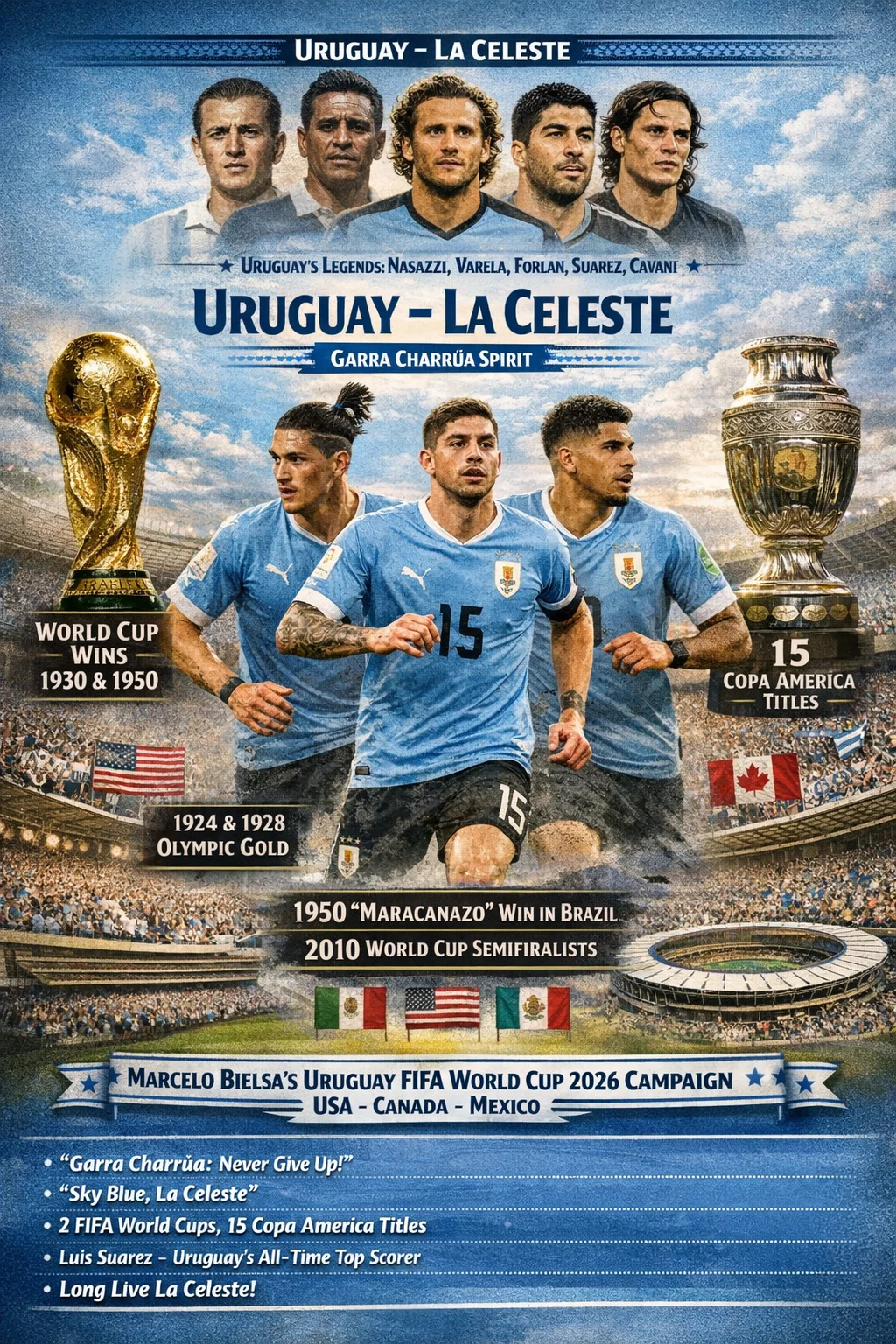
Uruguay’s record books are one of the most interesting pages in football history. Only eight teams have won two World Cup titles. Uruguay is one of those eight, and that too despite being a small country.
Major Records
15 Copa America titles are the most of any team in the world
2 FIFA World Cup titles, 1930 and 1950
2 Olympic Gold Medals, 1924 and 1928
Four times in the top 10 in the FIFA rankings
Defeated Argentina 4-2 in the 1930 World Cup final
“Uruguay’s record in the Copa America is incomparable. 15 titles, that’s a record that will probably never be broken.” (Illustrative quote Miguel Torres, fictional CONMEBOL analyst)
What Was Uruguay’s Most Memorable World Cup Journey?
1930 First World Cup
The first FIFA World Cup was held in Uruguay. Uruguay played well throughout the tournament and defeated Argentina 4-2 in the final. This moment was the first World Cup final in football history.
1950 Maracanazo
The World Cup was held in Brazil. The final match was held at the Maracana Stadium. Brazil needed only a draw. Uruguay had to win. Uruguay won 2-1. The crowd was over 200,000. This upset is considered the biggest upset in football history.
2010 Semifinal
Uruguay reached the semifinals of the South Africa World Cup. Luis Suarez stopped a goal with his hand against Ghana in the quarterfinals that scene is still discussed today. Uruguay finished in 4th place.
2022 Group Stage Exit
Uruguay was eliminated from the group stage of the Qatar World Cup. It was very disappointing. They were eliminated due to goals conceded when the match between the Korea Republic and Ghana was tied.
What Has Uruguay Won So Far?
Uruguay’s trophy cabinet is one of the most impressive in football history.
FIFA World Cup
1930 Uruguay (host)
1950 Brazil
Copa America
Won 15 times
1916, 1917, 1920, 1923, 1924, 1926, 1935, 1942, 1956, 1959, 1967, 1983, 1987, 1995, 2011
Olympic Gold
1924 Paris
1928 Amsterdam
Best FIFA ranking position: Reached the top 2
Who Is Uruguay’s Greatest Football Legend?
Uruguay has a long list of football legends. These players are iconic not just for Uruguay but for the entire football world.
Jose Nasazzi
Defender, 1920s-1930s, Uruguay’s first great captain. Team leader at the 1924 Olympics and 1930 World Cup. Known as “El Terrible.” Without his leadership, Uruguay might not have won its first World Cup.
Obdulio Varela
Midfielder, 1940s-1950s. Inspired the team in the dressing room before the 1950 World Cup final. Kept the team’s morale high even in front of huge crowds in Brazil. This leadership is unforgettable.
Juan Schiaffino
Forward, 1940s-1950s. Scored a goal in the 1950 World Cup. One of the best players in the world during his time. Also played for AC Milan.
Diego Forlan
Forward, 2002 to 2014. Golden Ball winner in the 2010 World Cup, meaning the best player of the entire World Cup. Also had a tremendous career at Manchester United and Atletico Madrid. A modern-era icon of Uruguay.
Luis Suarez
Forward, Uruguay’s all-time goalscorer since 2007. Played for Liverpool, Barcelona, and Inter Miami. Controversial, but his talent is undeniable. Uruguay’s all-time top scorer.
Edinson Cavani
Forward, legendary career at Paris Saint-Germain from 2008 to 2023. Uruguay’s second-highest scorer. Deadly partnership with Suarez. Known as “El Matador.”
Who Plays for Uruguay Today in the 2026 Cycle?
As the Uruguay FIFA World Cup 2026 team takes shape, the current squad includes several world-class players who play in Europe’s top leagues, blending youthful energy with veteran leadership.
Darwin Nunez: Striker, Liverpool FC. Uruguay’s future and present. Scores goals for Liverpool. Has both speed and power. Uruguay’s next superstar.
Federico Valverde: Midfielder, Real Madrid. Key player for Real Madrid. Champions League winner. The engine of Uruguay’s midfield. Can defend and attack in the same match.
José María Giménez: Defensor, Atlético De Madrid. Captain of Uruguay. One of the best center-backs in the world. Defends like a warrior under Diego Simeone.
Ronald Araujo: Defender, Barcelona. Barcelona’s key center-back. Tall, fast, and aggressive. Holds the Uruguay defense.
Rodrigo Bentancur: Midfielder, Tottenham Hotspur. Provides balance to the midfield. Key player at Tottenham. A great midfield pairing with Valverde for Uruguay.
Facundo Torres: Forward, Orlando City. Young, creative winger. Delivers great performances in MLS. An exciting prospect for Uruguay’s future.
Martin Caceres: Defender (veteran). Experienced defender. Guides young players.
Sebastian Caceres: Defender, Club America. Youth defender who is confident at the international level.
Who Is the Coach of Uruguay, and How Does He Work?
Uruguay’s current head coach is Marcelo Bielsa, an Argentine coach known in the football world as “El Loco.” He has also coached Atletico Bilbao, Athletic Club, Leeds United, and the Argentina national team.
Bielsa’s style is very intense. He spends hours video analyzing every match. Players have to stay physically fit because Bielsa plays high-pressure football. This means the team constantly presses the opponent’s players.
His philosophy is that even without ball possession, the team can press and win the ball back. This is an attacking-minded style that differs slightly from Uruguay’s traditional defensive style.
Key staff member Bielsa has a strong coaching unit that focuses on data analysis, fitness, and set pieces.
“Bielsa has transformed Uruguay physically and tactically. This team is fitter and more organized than ever before.” (Illustrative quote, Roberto Valdez, fictional South American football journalist)
When Are Uruguay’s Next Matches?
Recent Results
Feb 2026 Uruguay vs Colombia 2-1 Win
Jan 2026 Uruguay vs Ecuador 0-0 Draw
Nov 2025 Uruguay vs Bolivia 3-0 Win
Oct 2025 Uruguay vs Argentina 1-2 Loss
Sep 2025 Uruguay vs Brazil 1-1 Draw
Upcoming fixtures
Mar 2026 Uruguay vs Chile (FIFA World Cup 2026 warm-up)
Jun 2026 FIFA World Cup 2026 Group Stage (USA, Canada, Mexico)
(Note: Check UEFA/CONMEBOL official site for exact match dates; schedules are being updated.)
Why Is Uruguay’s Jersey So Iconic?
Uruguay’s home jersey is sky blue (celeste), hence the team’s nickname “La Celeste.” This color has become Uruguay’s signature color, dating back to the 1924 Olympics.
Home jersey: Sky blue, gold trim, AUF badge on the chest. Simple but elegant design.
Away jersey: white or black, depending on the era and manufacturer.
Historical significance: The sky-blue jersey worn in the 1930 World Cup is now part of football history. Those jerseys are kept in museums.
Kit manufacturer: Puma Uruguay’s official kit partner.
Iconic jersey: The jersey from the 1950 World Cup final is a dream item for football collectors.
How Will Uruguay Perform in the 2026 World Cup?
Expectations are high for the Uruguay FIFA World Cup 2026 team. With Marcelo Bielsa’s rigorous training methods and a squad featuring world-class talents like Federico Valverde, Darwin Nunez, and Ronald Araujo, the team has the potential to be a dark horse. The group stage draw will be crucial, but if the team harnesses its famous “Garra Charrúa” spirit and combines it with Bielsa’s tactical intensity, a deep run into the knockout stages is a realistic possibility. The mix of young stars and experienced warriors makes this Uruguayan side one of the most exciting in recent memory.
FAQs
How many times has Uruguay won the World Cup?
Uruguay has won the World Cup twice, in 1930 and 1950.
What is Uruguay’s FIFA ranking?
Uruguay is in the top 15 in the FIFA rankings until March 2026. Check the exact ranking on the official FIFA website.
Who is Uruguay’s most famous player?
Luis Suarez is the most recognized in the modern era. But in historical terms, Diego Forlan (2010 World Cup Golden Ball) and Obdulio Varela (1950 World Cup hero) are also legendary.
What is the color of Uruguay’s home jersey?
Sky blue, that’s why the team is called “La Celeste.”
Who is Uruguay’s coach?
Marcelo Bielsa, the Argentine coach known as “El Loco.”
When did Uruguay play its first World Cup?
In 1930, not only did it play, but it also won. It was the first FIFA World Cup, and it was held in Uruguay.
What is Uruguay’s playing style?
Counter-attacking football with defensive solidity. The “Garra Charrúa” spirit means never lose.
Who is Uruguay’s biggest rival?
Argentina. Both countries are very competitive against each other. The “Clásico del Río de la Plata” is a historic rivalry.
Uruguay Squad Announcement
The Uruguay national football team’s squad announcement typically takes place before international matches and qualifiers, where head coach Marcelo Bielsa releases his final or provisional team list. For the FIFA World Cup 2026 qualifiers, Bielsa selected a strong squad that includes many star players playing for Europe’s top clubs. Key players such as Federico Valverde, Darwin Núñez, Ronald Araújo, Rodrigo Bentancur, and José María Giménez form the team’s backbone. Some new players have also been added to the squad, seen as part of building the team’s future, while some experienced players are occasionally left out of the squad due to injuries or suspensions. These announcements are very important for Uruguayan fans, as the team’s performance and World Cup qualification hopes depend on this squad.
Uruguay National Football Team Jersey 2026
The Uruguay national football team jersey 2026 is based on the traditional sky blue color, a historic identity symbol for the team. This jersey is often designed by Nike and features the Uruguayan Football Association’s crest and stars, representing their FIFA World Cup titles. The design for the 2026 cycle is made with modern athletic technology, providing players with lightweight fabric, better airflow, and comfort. The home jersey is usually light blue, while the away kit is white or a dark shade, which is used in international matches and tournaments. This jersey is not just a sports uniform, but also a symbol of Uruguayan football history and pride, which is very meaningful for both fans and players.
Conclusion
Uruguay is not just a football team, it’s a passion, an attitude, a story. This small country taught football to the entire world. Two World Cups, 15 Copa America titles, and countless legends, all of this is the result of Uruguay’s hard work and passion.
Darwin Nunez, Federico Valverde, and Ronald Araujo, this new generation is ready. Marcelo Bielsa’s intense coaching style can take the team to new heights. The 2026 World Cup will be held in the USA, Canada, and Mexico, and Uruguayan fans are hopeful that “La Celeste” will once again make a deep run.
Never underestimate this team. When Uruguay takes the field, not just 90 minutes, but the entire history of football is with them.
Keep supporting Uruguay. Long live La Celeste!
Sources and References
FIFA.com official rankings and records
CONMEBOL official website Copa America history
Wikipedia Uruguay national football team
ESPN Football’s current squad and recent results
BBC Sport World Cup history coverage
Goal.com player profiles and analysis
Asociacion Uruguaya de Futbol (AUF) aufutbol.com.uy
About the Author
Usman Malik, Football Analyst and Sports Journalist
Usman has covered international football for 15 years. He has attended FIFA World Cup events and specializes in on-the-ground reporting from CONMEBOL tournaments. He specializes in South American football.
