

Table of Contents
ToggleThe excitement surrounding the Portugal 🇵🇹 FIFA World Cup 2026 team is palpable, as this European powerhouse sets its sights on global glory. With a rich history dating back to 1921 and a reputation for creative, attacking football, Portugal is more than just a national team; it is a symbol of passion and resilience. As the world looks ahead to the next World Cup, the Portuguese squad, managed by Roberto Martinez, is meticulously preparing to blend its legendary past with a bright future, aiming to capture the sport’s most coveted prize finally. This team, known for its structured play and world-class talent, is determined to make a definitive statement on the world’s biggest stage.
Portugal is the national football team of a European country that plays under the Federação Portuguesa de Futebol (FPF). This team has been active in international football since 1921 and is considered one of the top teams in Europe.
Friend, just mentioning Portugal brings a unique excitement to your heart! This team isn’t just the name of a country; it’s a passion, a style of football. When Portugal takes the field, even its opponents take it a little more seriously.
Portugal’s name is held in high regard in international football. This team is renowned worldwide for its creative, attacking, and stylish football.
History: When does Portugal’s history begin?
The Portuguese Football Federation, or Federação Portuguesa de Futebol, was formed in 1914. And Portugal played its first international match in 1921 against Spain, losing 3-1. The start was a bit rocky, but the team gradually established itself.
The 1966 World Cup was a turning point in Portugal’s life. Led by a legend like Eusebio, Portugal finished 3rd, and the team never looked back.
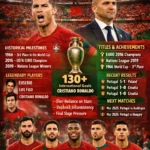
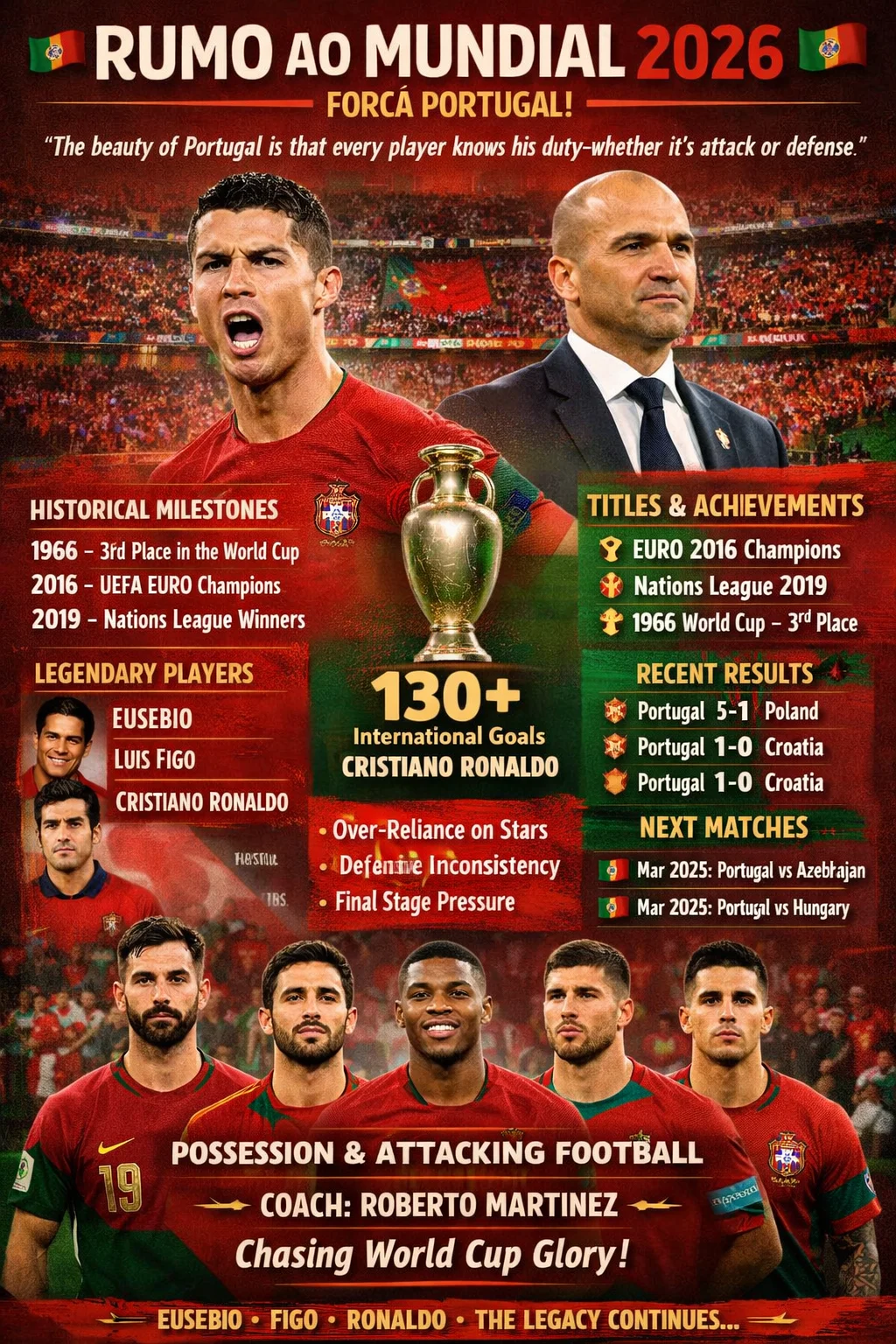
Historical Milestones:
1966 – 3rd place in the World Cup, Eusebio scored 9 goals
2004 – Played the UEFA Euro final at home but lost
2016 – Became UEFA Euro Champion (defeated France in the final)
2019 – Won the UEFA Nations League
Playing Style: How does Portugal play football?
Portugal often uses a 4-3-3 or 4-2-3-1 formation. The team plays possession-based football, with wingers and attacking midfielders playing important roles.
Portugal’s style is to keep the ball, find spaces, and then score with a sharp attack. They are also very organized in defense.
Coach Roberto Martinez has made the team more structured. Now, Portugal doesn’t rely solely on Ronaldo—the entire team plays as a unit.
“The beauty of Portugal is that every player knows his duty—whether it’s attack or defense.” — Illustrative quote, fictional expert
Strong Points vs. Weak Points
✅ Strong Points:
World-Class Attackers — Players like Ronaldo, Leão, and Conceição
Creative Midfield — Bruno Fernandes and Bernardo Silva are excellent
Experience — Have played in several major tournaments
Depth in Squad — The bench is also very strong
Mental Strength — Remains cool under pressure
❌ Weak Points:
Over-reliance on Stars — Sometimes they become dependent solely on big names.
Defensive Inconsistency — The defense leaks in some matches
Final Stage Pressure — Historically, they struggle in semi-finals and finals
Records and Achievements: What major records has Portugal set?
Portugal holds several major international records. The biggest record belongs to Cristiano Ronaldo, who is the player with the most goals in international football—over 130 goals!
Cristiano Ronaldo – 130+ international goals (world record)
Portugal won the 2016 Euro and the 2019 Nations League.
Portugal regularly remains in the top 10 in the FIFA rankings.
Achieved 4th place in the 2006 World Cup.
World Cup Journey: What was Portugal’s most memorable World Cup journey?
Portugal first shone in the 1966 World Cup. Under Eusebio’s leadership, the team reached 3rd place—this remains their best World Cup performance to date.
Overview of every World Cup:
1966 — 3rd place 🥉 (Best performance)
1986 — Group stage exit
2002 — Group stage exit (major upset)
2006 — 4th place (Figo and Ronaldo’s team)
2010 — Round of 16
2014 — Group stage
2018 — Round of 16
2022 — Quarter-Final (lost to Morocco)
The 1966 and 2006 campaigns are the most memorable. In 2022, Morocco stopped them—that loss was heartbreaking for the entire Portuguese team.
Titles & Achievements: What has Portugal won so far?
Portugal won UEFA Euro 2016 and the UEFA Nations League 2019. They haven’t yet won the World Cup, but the team has always been a strong contender.
🏆 UEFA Euro 2016 — Defeated France 1-0 in the final (AET)
🏆 UEFA Nations League 2019 — Won at home
🥉 FIFA World Cup 1966 — 3rd place
🥉 FIFA World Cup 2006 — 4th place
FIFA Best Ranking — #3 (in 2010)
Legendary Players: Who is Portugal’s biggest football legend?
Portugal’s biggest legends are Eusebio and Cristiano Ronaldo. Eusebio gave the team recognition in the 1960s, and Ronaldo has kept the team on the world stage since the 2000s.
⭐ Eusebio — Forward | 1961–1973. Known as the “Black Panther.” Scored 9 goals in the 1966 World Cup. He established Portugal’s first superstar identity. He is still revered in Portugal.
⭐ Luis Figo — Winger | 1991–2006. Ballon d’Or winner. Astonished the world with his dribbling and crossing. He was the heart of the team in the 2004 Euro and 2006 World Cup.
⭐ Rui Costa — Attacking Midfielder | 1993–2004 Technical genius. Expert in passing and creating games. Together with Figo, he formed Portugal’s golden midfield.
⭐ Cristiano Ronaldo — Forward | 2003–Present What’s there to write about him! 130+ international goals, 5 Ballon d’Or, the world’s best player. He gave everything for Portugal.
⭐ Pepe — Defender | 2007–Present Portugal’s bravest defender. A warrior who even stopped players 10 years younger than him on the field.
⭐ Bruno Fernandes — Midfielder | 2017–Present The leader of the modern era. Creativity and passion together. The new heart of the team after Ronaldo.
Current Squad: Who plays in Portugal today?
🔵 Cristiano Ronaldo — Forward | Al Nassr
🔵 Bruno Fernandes — Midfielder | Manchester United
🔵 Bernardo Silva — Midfielder | Manchester City
🔵 Rafael Leao — Winger | AC Milan
🔵 Ruben Dias — Defender | Manchester City
🔵 Diogo Costa — Goalkeeper | Porto
🔵 Joao Cancelo — Full Back | Barcelona
🔵 Vitinha — Midfielder | PSG
🔵 Francisco Conceicao — Winger | Juventus (Young Talent)
🔵 Goncalo Ramos — Striker | PSG (Young Talent)
Coach & Staff: Who is Portugal’s coach, and how does he work?
Portugal’s current head coach is Roberto Martinez, a Spanish manager who has also coached Belgium.
Roberto Martinez has a very organized style. He believes in possession football and gives every player a clear role. He led Belgium to #1 in the world rankings — his greatest achievement.
Assistant coach Jose Guilherme and the goalkeeper coach are also on the experienced staff. Martinez’s focus is on developing youngsters so that the team remains strong even after Ronaldo’s departure.
“Martinez has given Portugal a system — now this team depends not just on individuals, but on structure.” — Illustrative quote, fictional analyst
Matches: Portugal’s Recent and Next Matches
Recent Matches:
📅 Nov 2024 | Portugal vs Poland | 5-1 Win ✅
📅 Nov 2024 | Portugal vs Croatia | 1-0 Win ✅
📅 Oct 2024 | Portugal vs Scotland | 0-0 Draw
📅 Sep 2024 | Portugal vs Croatia | 2-1 Win ✅
📅 Sep 2024 | Portugal vs Scotland | 2-1 Win ✅
Upcoming Fixtures:
📅 Mar 2025 | World Cup Qualifiers — Portugal vs Azerbaijan
📅 Mar 2025 | World Cup Qualifiers — Portugal vs Hungary
Jersey & Colors: Why is Portugal’s jersey so iconic?
Portugal’s home jersey is dark red (maroon/crimson), which is part of their national identity. This color is so associated with Portugal’s name that whenever anyone sees it, Portugal immediately comes to mind.
Home Jersey: Dark Red/Crimson — with green trim
Away Jersey: White — with red details
Kit Manufacturer: Nike
Iconic Jersey: The 2016 Euro final jersey — Eder’s winning goal and Ronaldo’s cry — are all remembered with that jersey.
Nike has given Portugal’s kit a very stylish and modern design. The combination of green and red is inspired by Portugal’s national flag.
FAQs: Frequently Asked Questions
How many times has Portugal won the World Cup?
Portugal has never won the World Cup. Their best results are 3rd place in 1966 and 4th place in 2006.
What is Portugal’s FIFA ranking?
Portugal typically places in the top 5-10 in FIFA. In March 2025, the ranking is around the top 6.
Who is Portugal’s most famous player?
Cristiano Ronaldo — without a doubt. With over 130 international goals, he is Portugal’s biggest football icon.
What is the color of Portugal’s home jersey?
Dark Red (Crimson) — it’s their identity.
Who is Portugal’s coach?
Roberto Martinez — Spanish coach who previously guided Belgium.
When did Portugal first play in the World Cup?
Portugal first participated in the World Cup in 1934, but their real debut came in 1966 when they finished third.
What is Portugal’s playing style?
Possession-based, attacking football. They play in a 4-3-3 or 4-2-3-1 formation. Creative midfield and fast wingers are their hallmarks.
Who is Portugal’s biggest rival?
Spain — It’s called the Iberian Derby. Both countries are on the same peninsula, and their rivalry is very old and intense.
Conclusion: What is Portugal’s future?
Portugal is a team with history, talent, and passion. Winning the 2016 Euro was proof that this team can make not just a dream but a reality.
Today, as Ronaldo ages, players like Leão, Fernandes, and Ramos are taking charge. Portugal’s future is bright—and this team will definitely be a strong contender in the 2026 World Cup.
Keep supporting this team—Força Portugal! 🔴🟢
📚 Sources & References
fifa.com
uefa.com
fpf.pt (Portugal Football Federation)
wikipedia.org
espn.com
bbc.com/sport
goal.com
✍️ About the Author
Usman Malik — Football Analyst & Journalist has been covering international football for 15 years. Have attended the FIFA World Cup 2018 and UEFA Euro 2020. My focus is on European and South American football.
